Those of us living with cats share our homes with an ancestral predator, one adapted for hunting and the frequent, exclusive consumption of meat. These instincts become fully activated outside the domestic environment, where cats pose a global threat to wildlife.
Pets are family. We celebrate their arrival with the same joy as a grand homecoming, and their absence leaves a grief as deep as losing a loved one. In bonding with cats and dogs, we often attribute human abilities and emotions to them.
But beyond this affection, domestic animals still carry the instincts and genetic legacy of their wild ancestors(1, 2). My cats — Caruso, Muesli, and Plata — have been calm and loving, but they have always enjoyed a real hunt (3). When a moth comes in through a window, they seem possessed: their mouths chitter and make clicking sounds, they leap from one piece of furniture to another, and their heads snap sharply between the insect’s position and other points in the room, calculating the best spot from which to pounce on their prey. That is why when they become feral, cats and dogs integrate into food chains like any other species: they compete for ecosystem resources, hunt and are hunted, and hybridise and exchange diseases with other carnivores (4, 5).
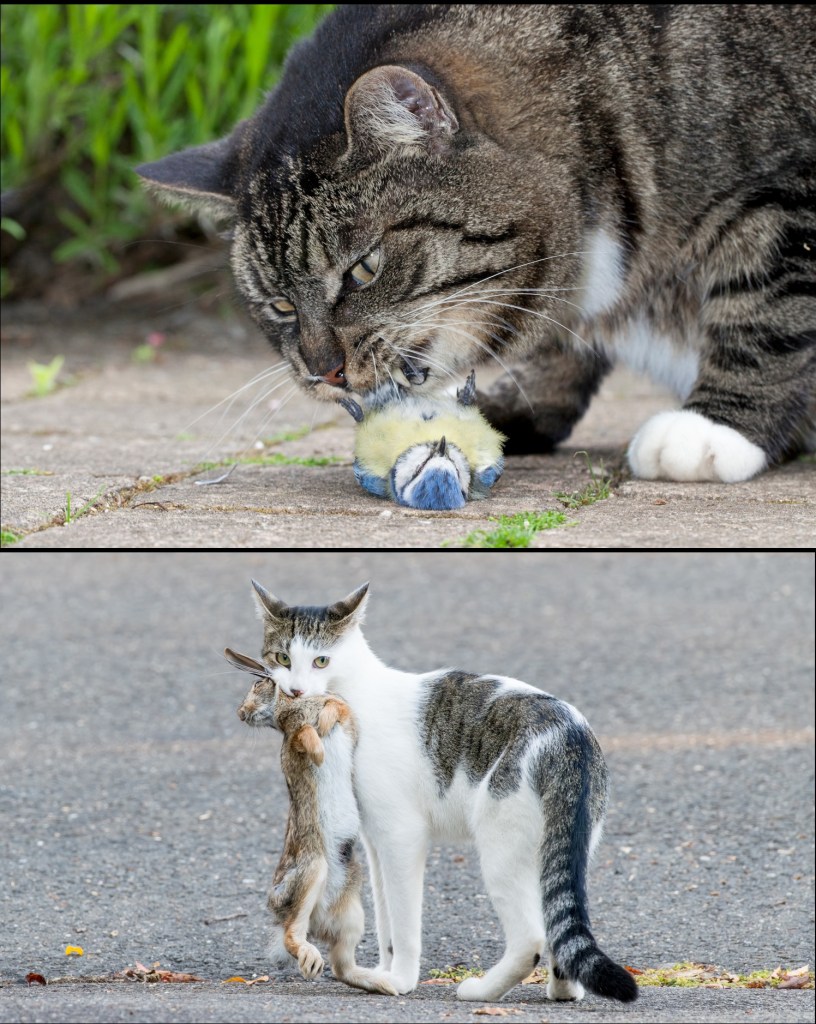
Domestic cats are highly skilled hunters, and their predatory interactions with a wide range of prey are widely documented in social media and documentaries. Some examples include cats catching: bats and birds on the wing, butterflies, chipmunks, dragons, fishes, grasshoppers, frogs, lizards, mice, owls, rabbits, seagulls, snakes, squirrels, and wallabies. See an award-winning photo depicting wildlife with fatal injuries caused by cats recorded in 2019 at a single animal hospital in the USA, and a video showing domestic cats mimicking bird calls and some cat owners explaining that their pets reject commercial cat food after experiencing the thrill of hunting real prey. The documentary Secret Life of Cats contextualises the ecological challenges posed by free-roaming cats.
Preference for native and diverse wildlife
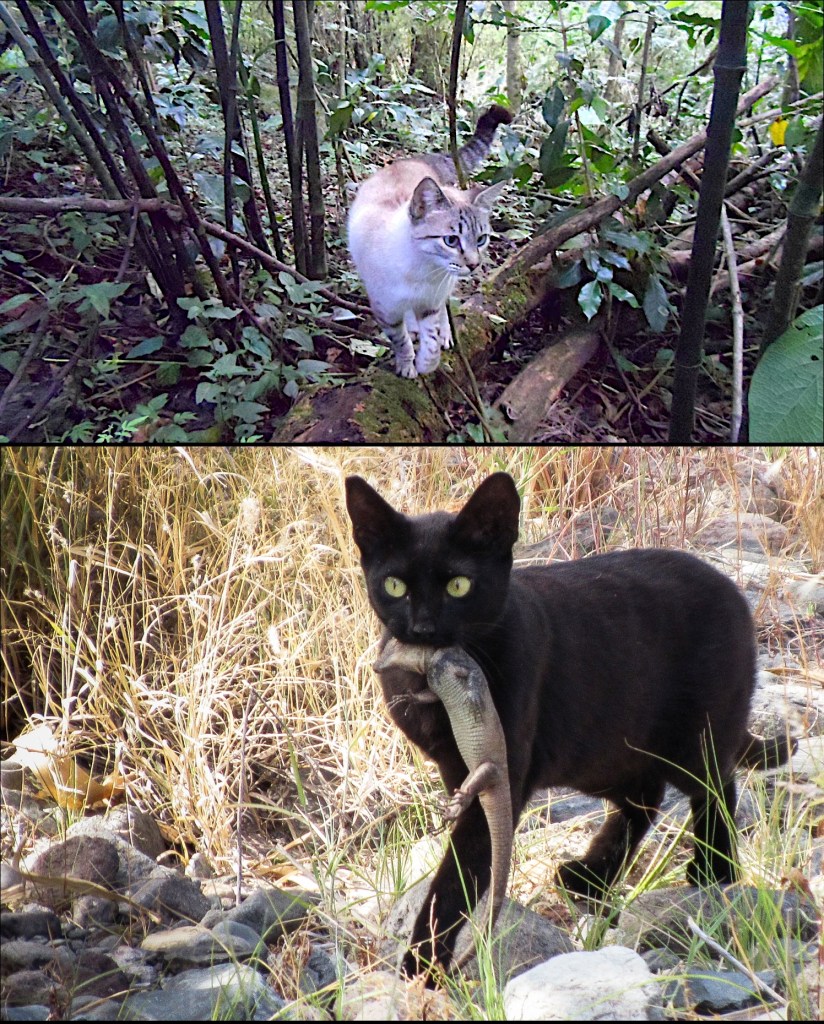
Isac Mella and collaborators studied the prey hunted by 120 domestic cats in the Mexican city of Xalapa (6). The research was made possible through the participation of 44 residents, who were given standardised instructions to collect the animals that their cats brought home each month. From March to August 2018, the felines killed a total of 246 prey (about 41 per month), belonging to 64 different species, with 9 out of 10 being native fauna.
In terms of numbers, reptiles (36%) and invertebrates (23%) made up more than half of the captures, with the rose-bellied lizard (Sceloporus variabilis) the most hunted species (38 individuals). Hunted birds and invertebrates topped the list in terms of diversity (17 species each), followed by reptiles (15 species), and amphibians and mammals (6-9 species). The study also found that striped cats were more successful hunters likely due to their camouflage, and that captures increased the longer the animals spent outdoors (6).

Adapted for constant hunting
Rats and cats are the most damaging predatory mammals to global biodiversity (6). Our cat companions hunt more than 2,000 species of wildlife, including 347 that are at risk of extinction and 11 that are already extinct (7). After being introduced to over 120 islands — most of them lacking natural predators — cats have caused 14% of vertebrate extinctions and currently threaten 8% of vulnerable birds, mammals, and reptiles (8). In countries like Australia (9,37), China (10) and the United States (11), cats kill millions to billions of prey animals every year (5). The problem is both pervasive and global, as the worldwide population exceeds 600 million cats (12-14) [read here and here] and 900 million dogs (4) [read here and here] — together equivalent to the human population of China!
This predatory prowess is no accident: cats are obligate carnivores (15). Unlike the more flexible diet of dogs, a cat’s metabolism is specifically adapted to process protein-rich food (16). Their sense of taste detects the amino acids in meat, but is insensitive to sweetness (17) and shows low sensitivity to saltiness [NaCl], likely due to the high sodium [Na] content in their natural diet of meat (18, 19).
The habit of domestic cats eating several small meals a day mirrors the behaviour of their wild counterparts that hunt and consume multiple small prey throughout the day. Likewise, their tendency to lose interest in repetitive meals at home reflects an innate drive to seek prey variety, likely evolved to prevent nutritional deficiencies in their natural environment.
In short, domestic cats are evolutionarily solitary and territorial animals, compelled to hunt frequently to survive (20). This evolutionary background also explains why cats are generally more independent than dogs (21): cats grant us the privilege of living with them, while dogs — descended from the highly social wolf (22, 23) — can suffer stress or depression when left alone [watch Cats vs. Dogs: Which is Best?].
Invasive in the wild
As a domesticated animal, the cat has no native distribution. Wherever these domestic mammals live in a feral state, they qualify as an exotic invasive species (24). Even when wearing a collar or carrying a microchip, a domestic cat roaming beyond the confines of a human home should be considered a non-native invasive animal.
In Australia, for example, domestic cats with outdoor access kill more wildlife than feral cats (9). However, in many countries such as Spain, domestic cats are not included in official invasive-species lists, creating a legal gap that hampers action. Control measures range from eradication campaigns and euthanasia, sometimes combined with sterilisation followed by release or placement into adoption programs (24, 25).
Strategies vary depending on factors like cat population density, their presence in protected natural areas or available funding. Ironically, although animal welfare advocates and conservationists often share common goals, the issue of domestic cats preying on endangered wildlife has created a deep divide between them.
Hawai’i exemplifies this conflict [watch]: feral cats contribute to the decline of endangered seabirds through direct predation (27), and threaten Hawaiian monk seals (Neomonachus schauinslandi) by spreading the protozoan parasite Toxoplasma gondii (26) that reproduces only in cat hosts (domestic, feral, and wild species). Despite this clear conservation threat, efforts to control feral cat populations face strong opposition from animal welfare groups, illustrating the tension between protecting native wildlife and concern for cat welfare.
Ideally, domestic cats should be kept indoors. If you share your life with cats, giving them full freedom to roam outdoors increases their range and the impact on wildlife, while also exposing them to greater health risks (27). For insights, watch cat management efforts in Canada and watch cat-tracking research.
If you do allow your cats outside, at the very least, restrict their outings to times when wildlife is less active (28). All measures require public support and an informed citizenry (29), because the initial reaction is often negative. People tend to see not the predator they live with, but the beloved family member they have adopted — and that emotion is projected uncritically onto all cats everywhere.
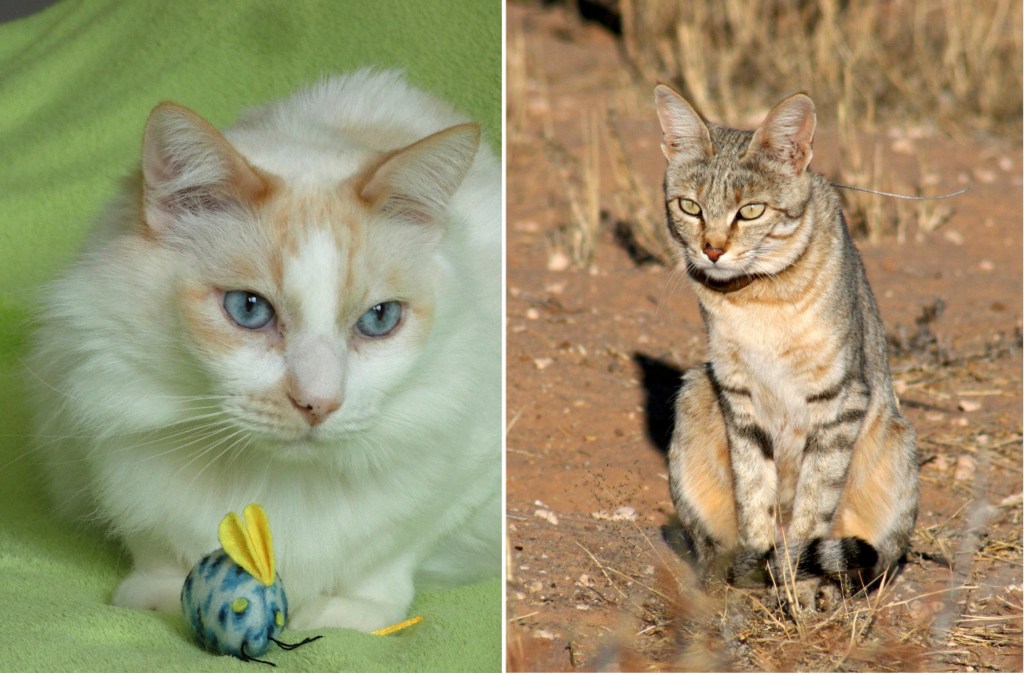
Ancestry of domestic cats. On the left, my cat Caruso with one of his fabric mice, which he often hunts at home as if it were real (Móstoles, Spain). On the right, a female African wildcat (Felis silvestris lybica) wearing a study radio collar in Kgalagadi Transfrontier Park (Botswana) — watch the species hunting birds, mice and termites. There are five subspecies of wildcat (genus Felis) in Africa and Eurasia (31) [watch wildcat diversity]. Genetics confirm that the domestic cat shares its closest common ancestor with the African wildcat [watch evolutionary story here and here] tamed in ancient Mesopotamia (2). The first tomb containing a cat, alongside the deceased’s belongings, dates to around 9,500 years ago at the Neolithic settlement of Shillourokambos, Cyprus (32). Cat domestication [watch archaeological story] might have begun with individuals that approached human settlements, where they only reproduced among themselves (33), while people tolerated them for their effectiveness in controlling pests like mice (34). The Egyptians already selectively bred different varieties, and their spread accelerated with Roman trade routes (34). Selective breeding became widespread after the Middle Ages, when coats other than the wildcat’s grey became common (1). Over time, domestic cats have evolved a range of adaptations tailored to facilitate living alongside humans (35). For example, they meow in a shorter, sharper tone than the wildcat to please and engage with people (36). Watch documentary Cat Tales exploring the human-cat history. Photos courtesy of Clara Inia Herrando (Caruso) and Marna Herbst (African wildcat).
References
- Ottoni C et al. (2017). The palaeogenetics of cat dispersal in the ancient world. Nature Ecology & Evolution 1: 0139
- Driscoll CA et al. (2007). The Near Eastern origin of cat domestication. Science 317: 519-523
- Shajid Pyari M et al. (2021). Inexperienced but still interested – indoor-only cats are more inclined for predatory play than cats with outdoor access. Applied Animal Behaviour Science 241: 105373
- Hughes J & Macdonald DW (2013). A review of the interactions between free-roaming domestic dogs and wildlife. Biological Conservation 157: 341-351. https://doi.org/10.1016/j.biocon.2012.07.005.
- Loss SR et al. (2022). Review and synthesis of the global literature on domestic cat impacts on wildlife. Journal of Animal Ecology 91: 1361-1372
- Mella-Méndez I et al. (2022). Predation of wildlife by domestic cats in a Neotropical city: a multi-factor issue. Biological Invasions 24: 1539-1551. https://doi.org/10.1007/s10530-022-02734-5.
- Lepczyk CA et al. (2023). A global synthesis and assessment of free-ranging domestic cat diet. Nature Communications 14: 7809
- Medina FM et al. (2011). A global review of the impacts of invasive cats on island endangered vertebrates. Global Change Biology 17: 3503-3510
- Legge S et al. (2020). We need to worry about Bella and Charlie: the impacts of pet cats on Australian wildlife. Wildlife Research 47: 523-539
- Li Yet al. (2021). Estimates of wildlife killed by free-ranging cats in China. Biological Conservation 253: 108929
- Loss SR, Will T & Marra PP (2013). The impact of free-ranging domestic cats on wildlife of the United States. Nature Communications 4: 1396
- Mori E et al. (2019). License to kill? Domestic cats affect a wide range of native fauna in a highly biodiverse Mediterranean country. Frontiers in Ecology and Evolution 7: 477
- Rowan AN, Kartal T & Hadidian J (2019). Cat demographics & impact on wildlife in the USA, the UK, Australia and New Zealand: facts and values. Journal of Applied Animal Ethics Research 2: 7-37
- Bischof R et al. (2022). Mapping the “catscape” formed by a population of pet cats with outdoor access. Scientific Reports 12: 5964
- Bradshaw JWS et al. (1996). Food selection by the domestic cat, an obligate carnivore. Comparative Biochemistry and Physiology A 114: 205-209
- Russell K, Murgatroyd PR & Batt RM (2002). Net protein oxidation is adapted to dietary protein intake in domestic cats (Felis silvestris catus). Journal of Nutrition 132: 456-460
- Li X et al. (2005). Pseudogenization of a sweet-receptor gene accounts for cats’ indifference toward sugar. PLoS Genetics 1: e3
- Bradshaw JWS (1991). Sensory and experiential factors in the design of foods for domestic dogs and cats. Proceedings of the Nutrition Society 50: 99-106
- Li P & Wu G, in Nutrition and Metabolism of Dogs and Cats, G Wu, Ed. (Springer Nature Switzerland, Cham, 2024), pp. 55-98
- Bradshaw JWS (2006). The evolutionary basis for the feeding behavior of domestic dogs (Canis familiaris) and cats (Felis catus). Journal of Nutrition 136: 1927S-1931S
- Pongrácz P & Lugosi CA (2024). Predator for hire: the curious case of man’s best independent friend, the cat. Applied Animal Behaviour Science 271: 106168
- Larson G (2021). The question of canine origins. Science 374: 541-541
- Ollivier M et al. (2018). Dogs accompanied humans during the Neolithic expansion into Europe. Biology Letters 14: 20180286
- Trouwborst A, McCormack PC & Martínez Camacho E (2020). Domestic cats and their impacts on biodiversity: a blind spot in the application of nature conservation law. People and Nature 2: 235-250
- Boone JD et al. (2019). A long-term lens: cumulative impacts of free-roaming cat management strategy and intensity on preventable cat mortalities. Frontiers in Veterinary Science 6: 238
- Robinson SJ, Amlin A & Barbieri MM (2023). Terrestrial pathogen pollutant, Toxoplasma gondii, threatens Hawaiian monk seals (Neomonachus schauinslandi) following heavy runoff events. Journal of Wildlife Diseases 59: 1-11
- Cecchetti Met al. (2022). Spatial behavior of domestic cats and the effects of outdoor access restrictions and interventions to reduce predation of wildlife. Conservation Science and Practice 4: e597
- Chung HJ et al. (2024). Safe or sound? Factors influencing outdoor access, cat behavior, and hunting history with implications for conservation and welfare. Applied Animal Behaviour Science 280: 106425
- Deak BP et al. (2019). The significance of social perceptions in implementing successful feral cat management strategies: a global review. Animals 9: 617
- Loyd KAT et al. (2013). Quantifying free-roaming domestic cat predation using animal-borne video cameras. Biological Conservation 160: 183-189
- Steyer K et al. (2016). Large-scale genetic census of an elusive carnivore, the European wildcat (Felis s. silvestris). Conservation Genetics 17: 1183-1199
- Vigne J-D et al. (2004). Early taming of the cat in Cyprus. Science 304: 259-259
- Driscoll CA, Macdonald DW & O’Brien SJ (2009). From wild animals to domestic pets, an evolutionary view of domestication. Proceedings of the National Academy of Sciences of the USA 106: 9971-9978
- Faure E & Kitchener AC (2009). An archaeological and historical review of the relationships between felids and people. Anthrozoös 22: 221-238
- Natoli E, Litchfield C & Pontier D (2022). Coexistence between humans and ‘misunderstood’ domestic cats in the Anthropocene: exploring behavioural plasticity as a gatekeeper of evolution. Animals 12: 1717
- Nicastro N (2004). Perceptual and acoustic evidence for species-level differences in meow vocalizations by domestic cats (Felis catus) and African wild cats (Felis silvestris lybica). Journal of Comparative Psychology 118: 287-296
- Philippe-Lesaffre M et al. (2025). Differential ecological impacts of free-ranging cats among continents. Ecography 2025: e07169






Leave a Reply